
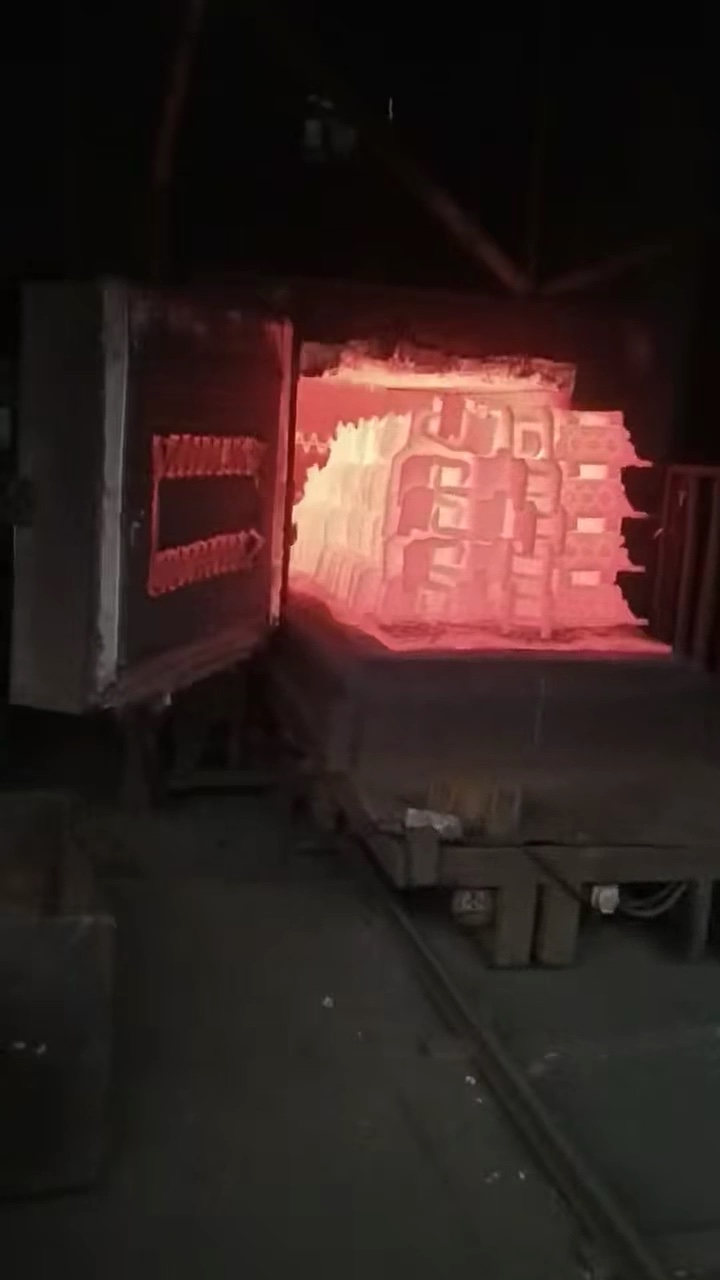
Why consider heat treatment after casting?
Different wall thicknesses and rates of heat loss cause different cooling rates across a steel casting. Some regions may develop coarse grains, and certain compositions and cooling conditions can produce Widmanstätten ferrite. Solidification shrinkage and uneven cooling can also leave residual casting stresses. Consider grade, section thickness and service requirements when deciding on heat treatment.
What normalizing does
Normalizing heats the casting above the applicable transformation range, holds it for the specified time, then cools it in air. Around 900 °C is a reference temperature used for normalizing some common carbon steel castings. The actual cycle depends on the grade, section thickness and approved process. Normalizing can refine grains and make the structure more uniform.
The purchase specification may call for normalizing, normalizing and tempering, or quenching and tempering, depending on the grade and drawing requirements.
ASM Handbook · Normalizing of Steel · SFSA Research Report 94A · Table 1.1
Wontide examples and furnace-load test bars
Wontide operates a normalizing furnace at its Laizhou workshop. A published example is a ZG270-500 cast steel leaf spring seat, normalized, machined and delivered as a finished part. The case records dimensional, chemical composition, tensile, impact, hardness and metallographic checks. A ZG270-500 bracket for agricultural machinery was also normalized and delivered machined. The historical ZG230-450 steel pile tip programme for Japan from 2013 to 2017 used normalizing.
During normalizing, Wontide places separately cast test bars in the furnace with the parts. They undergo the same furnace heating and holding schedule and are air-cooled as specified. Tensile and impact testing follows the applicable standard or agreed inspection plan. Furnace records link the results to the heat-treatment load. If the order calls for specimens taken from the casting or a defined scope of representation, state that in the drawing or technical agreement.
- See the cast steel leaf spring seat case
- See the machined agricultural bracket case
- See the historical cast steel pile tip case
What to specify in the RFQ
Put these four items in the drawing, RFQ or technical agreement so suppliers price the same scope and receiving inspection has clear acceptance criteria.
- Heat-treatment condition · State the required delivery condition, such as normalized, normalized and tempered, or quenched and tempered.
- Mechanical acceptance criteria · State the material standard and grade, and specify which requirements apply for yield strength, tensile strength, elongation, impact energy or hardness.
- Test coupons and sampling · Specify separately cast coupons heat-treated with the parts, integrally cast coupons, or samples taken from the casting. Agree whether sampling is by melt heat, heat-treatment load or lot.
- Reports and traceability · List the heat-treatment records, mechanical test reports or metallographic reports required and agree how they will be linked to the melt heat and heat-treatment load.